Is Your Neighbour's Wasp Nest Your Problem Too?
At first glance, a wasp nest on a neighbouring property might seem like something you can safely ignore. After all, the nest is not attached to your home, it’s not in your roof, that is where the thought process ends. Unfortunately, wasps do not recognise fences, garden boundaries, or property lines, and the impact of a nest often extends far beyond the house it is attached to.
We regularly attend properties where homeowners are distressed by heavy wasp activity in their garden, only to discover that the source of the problem is not their own home at all. Instead, the nest is next door, sometimes just a few metres away. This situation raises a difficult question: whose responsibility is it when one household’s nest becomes another household’s daily problem?
When one nest affects multiple homes
Time and again, we are called out to treat a wasp nest and notice that the neighbouring property also has a nest, or at the very least, a significant wasp issue. Often, when this is mentioned, the neighbours appear indifferent. Some will say the wasps are not bothering them, while others openly admit they would rather save their money than pay for treatment.
From our perspective, this attitude is un-neighbourly. A wasp nest does not operate in isolation. Wasps exiting a nest that is high up, such as under eaves or in a loft space, typically fly out in a straight line for a short distance before dropping down to ground level. This means that by the time they descend, they are often already in the neighbouring garden.
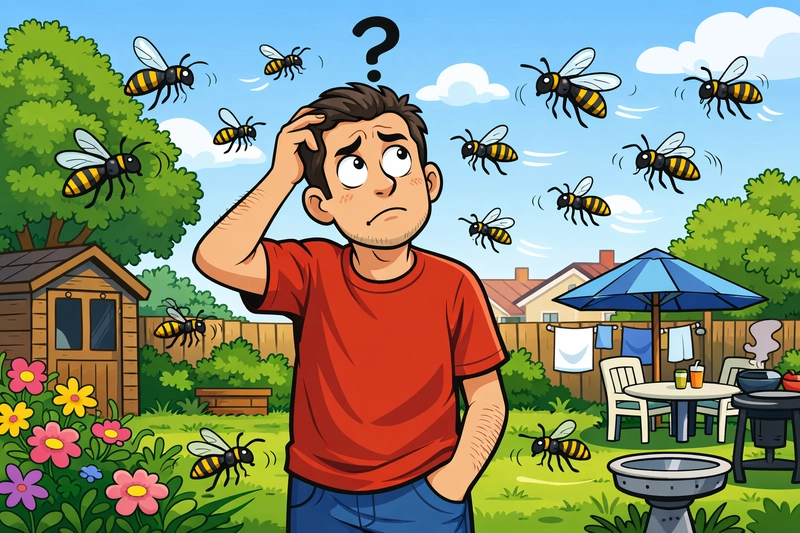
In many cases, the people suffering the most are not the ones living with the nest. Instead, it is the next-door neighbour who cannot enjoy their garden, let their children play outside, or hang washing without being plagued by wasps. This can feel deeply unfair, particularly when the source of the issue is clearly visible and easily addressed.
The flight path problem
Understanding how wasps move helps explain why this situation is so common. A nest located high on a property may appear quiet from below, giving the impression that it is not causing any trouble. However, the wasps leaving that nest are quickly travelling outward, often over fences, hedges, and walls.
Once they drop down to forage, they may be directly over a neighbour’s lawn, patio, or flower beds. From the perspective of the affected neighbour, it can look as though the wasps are coming from nowhere. They may check their own roof, shed, and trees repeatedly, finding nothing, while the real source remains just out of sight.
This is why disputes can arise. One household sees no issue and feels no urgency to act. The other feels under siege and frustrated that the problem is not being taken seriously.
Identical houses, confused wasps
On housing estates where all the houses look identical, the situation can become even more confusing. It may sound strange, but wasps do make mistakes. We have encountered this many times over the years.
A homeowner may contact us because wasps are repeatedly appearing in one specific area of their house, such as around a particular window or section of guttering. Upon arrival, something does not add up. There is no visible nest, no clear entry point, and the wasps appear confused, circling and behaving strangely.
In these cases, a wider inspection of the row of houses often reveals the real nest a few doors along, located in exactly the same position on a near-identical property. The wasps, guided by visual landmarks rather than house numbers, have become disoriented and are returning to the wrong address.
This leads to a situation where one homeowner is dealing with constant wasp activity, while the person with the actual nest may be barely aware of it.
Why indifference causes bigger problems
If you have a wasp nest and it is not bothering you right now, it can be tempting to ignore it. Wasps are seasonal, and many people hope the problem will simply disappear on its own. While it is true that nests are not reused the following year, this does not help the people affected during the current season.
As summer progresses, nests grow larger, and wasp numbers increase. What starts as a minor inconvenience can quickly escalate into aggressive behaviour, particularly later in the season when food sources become scarce. This increases the risk of stings, especially for children, pets, and anyone with allergies.
Ignoring a nest does not make it harmless. It simply shifts the burden onto others who may have no control over the situation.
Shared spaces and shared responsibility
In closely built areas, gardens, paths, and outdoor spaces are often used by multiple households. Wasps drawn to fallen fruit, bins, or outdoor meals will not discriminate based on who owns the nest. This shared environment means that one person’s decision can affect many others.
Considering how your actions, or lack of action, impact those around you is part of being a good neighbour. Addressing a wasp nest promptly can prevent tension, complaints, and potential injuries.
Thinking beyond your own property
If you discover a wasp nest on your home, even if it seems quiet or out of the way, it is worth thinking beyond your own immediate experience. Ask yourself whether your neighbours might be seeing more wasps than you are, or whether the nest’s location could be sending wasps directly into someone else’s garden.
Communication can make a significant difference. Letting neighbours know about the nest and your plans to deal with it can ease concerns and prevent misunderstandings. In some cases, neighbours may even be willing to contribute if they are directly affected.