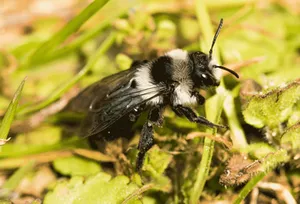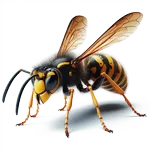
Wasp nest and Hornet nest Identification.
If you suspect that there may be a wasp nest nearby, it's essential first to confirm that the insects are indeed wasps and not another type, such as bees. Identifying insects with similar size and appearance, especially when it comes to wasp identification, can be challenging. We have included a photo and video guide to address this issue as a helpful resource for your wasp identification efforts. This comprehensive tool will help you compare visual and behavioural characteristics, highlighting the differences between wasps, hornets, and bees.
Compare the difference between a Wasp, Hornet and Bee.
By observing the suspected wasps closely, you can determine whether they are actually wasps, hornets, or bees.
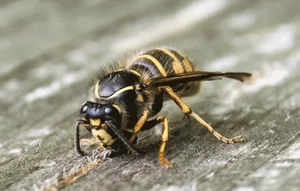
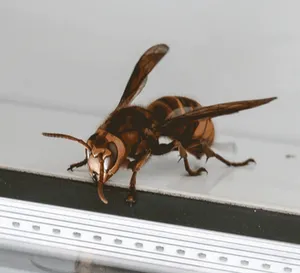
The photos below clearly depict the physical differences among these four primary contenders.
1. The Wasp!
- Population: The numbers gradually increase in spring, ranging from one to potentially reaching the high hundreds or even thousands later in the summer.
- Size: Typically around 18mm in length, though there can be variations.
- Preferred Locations: Commonly found in roof spaces (lofts) but can inhabit various places, including holes in the ground.
- Flight Behavior: Moves swiftly in straight lines, with minimal clustering at the nest entrance.
- Sounds: Nest may produce clicking, tapping, or scratching noises.
- Foraging Behavior: Individuals often return to the nest carrying insect parts in their mouths.
- Physical Appearance: Not characterized by a fluffy exterior.
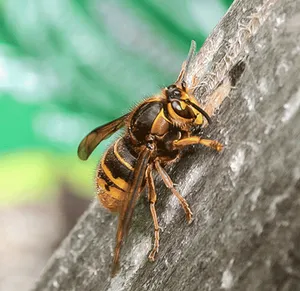
2. The Hornet!
- Population: Numbers gradually increase in spring, starting from one and potentially reaching 100 or more later in the summer.
- Size: Typically around 25-35mm in length, with some variations in size.
- Preferred Locations: Commonly found in roof spaces (lofts), sheds, and hollow trees.
- Flight Behavior: Displays relatively slow flight in straight lines.
- Sounds: Nest may produce clicking, tapping, or scratching noises.
- Foraging Behavior: Individuals often return to the nest carrying insect parts in their mouths.
- Activity Patterns: Nocturnal, their presence can be noticeable as they may hit against windows at night.
- Physical Appearance: Not characterized by a fluffy exterior.
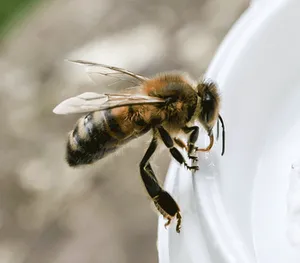
3. The honey bee!
- Population: Typically found in the thousands.
- Preferred Locations: Chimneys in residential housing and holes in hollow trees.
- Size: Approximately 15mm in length, similar in size to wasps.
- Flight Behavior: Exhibits relatively fast flight with long back legs hanging down when flying. Clustering often occurs at the nest entrance.
- Sounds: High-pitched buzzing noises emanate from the nest, resembling a roaring noise when in chimneys due to the large number of bees.
- Foraging Behavior: Bees may have visible pollen on their legs when returning to the nest.
- Physical Appearance: Noteworthy for having fluffy backs.
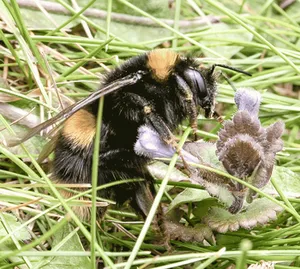
4. The Bumble Bee!
- Population: Numbers gradually increase in spring, starting from one and reaching 50-100 later in the summer.
- Size: Approximately 20mm in length, larger than tree bumble bees.
- Preferred Locations: Commonly found in holes in the ground and compost heaps. Tree bumble bees may also inhabit roof spaces.
- Flight Behavior: Exhibits relatively slow flight, often flying around in circles. Tends to gather at the nest entrance.
- Sounds: Produces loud squeaking/chirping and buzzing sounds when inside the nest.
- Physical Appearance: Large, black, fluffy, and known for being noisy.
It is easy to recognize a wasp or hornet nest when you see a continuous flow of these insects coming and going from it. Our videos provide practical examples to help you distinguish between a wasp or hornet's nest and a colony of honey or bumblebees.
A wasp or hornet nest can be compared to Heathrow Airport's bustling activity, where one lands and another takes off, resembling an air traffic control scenario. Wasps only briefly linger around the nest entrance; a busy nest might even have wasps queuing up to enter as they are on a mission.
Bees, including bumblebees, behave differently from wasps. They cluster around the nest entrance, engaging in chaotic mating flights, but are not as determined as wasps. You can confirm if the nest is active by observing them going in and paying attention to their departure.
Wasps exit the nest abruptly, resembling a firework going off, having delivered their catch and being eager to resume hunting. Keep an eye out for this swift departure, as it is a crucial indicator.
Wasp and Hornet nest identification - what to look for...
When do wasps make their nests?
Queen wasps begin building new nests in the spring and do not reuse old ones from previous years. During this period, which usually starts mid-March, queen wasps emerge from hibernation in response to increasing temperatures.
In an average year, small and active wasp nests become noticeable from the end of May onwards. However, there may be variations, with some nests appearing earlier or later, depending on the local temperatures influenced by microclimates.
It can be challenging to detect the activity of a single wasp, so it's advisable to wait until the queen rears some worker wasps before attempting to locate nests. We recommend you start searching for new or active nests around mid-June. When looking for activity, spend ten minutes on each side of your house and scan the roof, gutter areas, lead flashing around chimneys, vent pipes, and any other potential entry points for wasps. If activity is evident in multiple areas, it suggests the presence of numerous nests.
As the worker wasp population reaches hundreds or even thousands, their visibility becomes unmistakable by mid-summer, with heightened activity and a noticeable stream of insects departing and returning to the nest entrance.
Video of wasp nests to help show you what to look for.
We have put together a short video to help you identify if you have a nest.
In the video you will see four separate wasp nests; the first nest entrance is on the side of a chimney where the wasps (common) are entering into the roof space through an opening next to the brickwork.
Take a look at our second video.There are shots of a German wasp nest in a bush, a nest in the soffit of a house, a nest in a loft and finally a nest in a shed wall.
On our third video there is a rather large "busy" common wasp nest minutes after treatment. This hyperactive response to nest interference is an excellent example of how some people can get into bother when trying to eradicate a nest with DIY methods.
How can I tell if a wasp nest is active?
It can be challenging to distinguish between old nests from previous years and new ones built in the spring. Here are some guidelines to help you differentiate between the two:
Size Consideration:
If you come across a wasp nest in the spring larger than a football and no live wasps are walking around on its exterior, it is likely an old nest from a previous year.
Observation of Small Nests:
For smaller nests roughly the size of a golf ball, observe it for about 10 minutes. If a wasp returns to the nest during this time, it indicates that the nest is new and currently active.
Growth Over Time:
More wasps will emerge as nests grow during the spring and early summer. By mid-June, most nests will have wasps walking on the outside surface as they engage in repairs and expansion. Old nests often appear worn and tattered, while newly built ones are bright and fresh.
Individual Growth Rates:
Nests may grow at different rates, with some being more advanced than others. Nature exhibits variability, and there can be extreme cases.
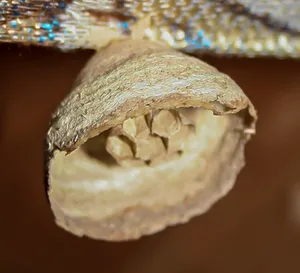
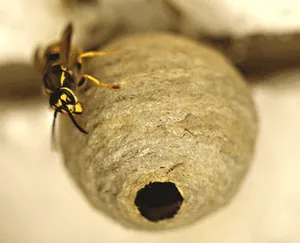
Where do wasps build their nests?
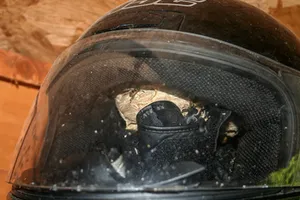
Wasps and hornets are skilled at building their nests in various, sometimes hard-to-reach places. Although they commonly build their nests in attic spaces, they can also be found in garden sheds, air bricks, behind tile hanging, or virtually any accessible and dry area. In addition, they may construct their nests underground, using old rabbit burrows or tunnels previously inhabited by mice or voles.
While they prefer warm, dark, and undisturbed loft spaces, sometimes wasps and hornets build their nests in exposed locations. It's important to note that not all nests take the classic ball-shaped form, as they can adapt to different structures. Nests might be flat and spread out, fitting the contours of their space. For instance, nests can be constructed within wall cavities, filling the void and adapting to the available space. This flexibility in nest shape allows wasps to adapt to various environments.
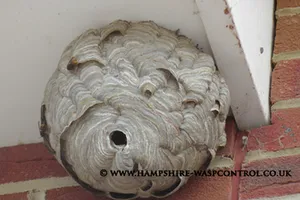
Why do I get a wasp nest every year?
It's common for people to wonder why they get a wasp nest in their home every year. The answer is usually related to the location of their home. Certain areas are more attractive to wasps than others. It's important to understand that this is not a personal attack, and the wasps are not targeting you.
If you find a wasp nest in your loft or shed every year, the wasps have easy access to that space and provide them with a dry and warm environment. Allowing the nest to mature and release new queens in the fall can increase the chances of another nest the following year. If you notice dead wasps inside your home regularly, it's a clear sign that there is a nest nearby. To locate the nest, inspect the outside of your home carefully, paying attention to areas such as the roof, fascia, air bricks, or any gaps where the wasps could enter the building.
European (German) Wasps & other wasps
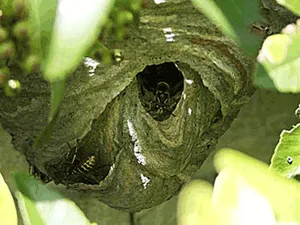
German wasps build their nests in trees, bushes and hedgerows and will look like a grey ball type structure attached to a branch.
The nest can sometimes be very challenging to see.
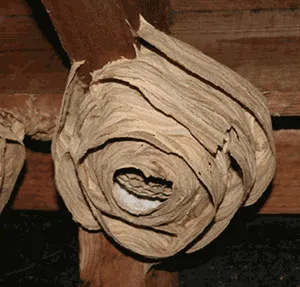
Below is a common wasp nest (generally found in lofts and sheds) for comparison.
The majority of other types of wasp in the UK are small parasitic wasps which pose no risk to humans. There is another type of social wasp, the "Median Wasp" but these are quite rare. The nests are similar to other social wasps but have an entry tube at the bottom.
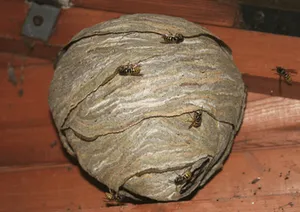
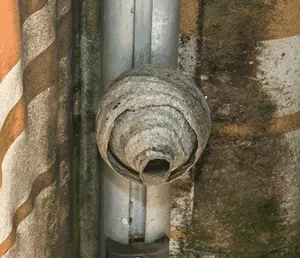
Please be sure that you have identified that your problem is in fact wasps or if you have found a nest that it is an active nest, we don’t want to waste your time or ours by attending an empty nest or worse still, a bee nest which we will not treat.
Both Wasp and Hornets nests are treated using the same method; take a look at our treatment page to see how we will manage your Wasp or Hornet's nest.
Once you are sure, you have an "active" Wasp or Hornet's nest on your property, visit our Hampshire Wasp area map to find out who covers your area. Or use our postcode search near the top of our pages.
I have big wasps?
You may notice large wasps in the spring, between March and early June. These queen wasps have just emerged from hibernation and are starting to build new nests. You can identify them by their slightly plumper appearance compared to worker wasps. By early June, after the queen has hatched some workers, she stays in the nest while the workers attend to her needs.
Towards the end of autumn, you might again observe these larger wasps. These are newly hatched queens that have recently emerged from the nest, mated, and are preparing to hibernate over the winter. Once these queens emerge in the autumn, they do not return to the nest. They are individual insects unattached to any nest or colony.
It's important to note that if you treat a nest in the autumn and queens have already emerged, the treatment will not affect these queens, potentially leaving live queen wasps in the area where the nest was. The emergence of queens in late summer or autumn varies yearly, occurring in August in some years and late September in others.
Suppose queens have emerged before treating a nest. In that case, some may find their way into the house, especially if the nest is in your loft or another part of your home. These queens are attracted to light and can squeeze through the smallest gaps.
During winter, if you notice large wasps entering your home, these are likely queens hibernating in your house, particularly in the loft area. They are awakening due to a temperature increase, which can be caused by either mild weather outside or central heating inside. Queen wasps emerge from hibernation in response to a temperature shift, mistakenly thinking spring has arrived. Seeking light, they move towards any light source, believing it leads to the outdoors.
Other potential candidates...
I have a wasp nest!
There is a common misconception that wasps swarm, but they do not. If you see a group of insects you think are wasps, it's worth looking closer because they are most likely honey bees. You can watch a bee swarm video to distinguish between the two.
Suppose you have a honey bee swarm. In that case, contacting a local beekeeper or beekeeping association is essential to collect and relocate the swarm safely. Rehoming swarms helps to preserve native bee colonies. Honey bees are known to swarm into chimneys, so if you suddenly find bees entering your house through the fireplace, it's likely a honey bee swarm in your chimney. In such cases, seeking assistance from a local beekeeping association is necessary.
Notably, honey bees send out scout bees to explore potential nest sites before swarming. If you see a few scouting bees, you may need to wait until the swarm arrives before someone can address the situation. Typically, scouting starts with a few bees and increases to 50 or more on the second day.
The swarm season varies depending on weather and temperature, but it generally starts from mid-April onward. It's rare for wasps to nest in chimneys, with only a few cases reported annually.
Bumblebees!
Many people mistake bumblebees for wasps during spring, especially the relatively new-to-the-UK species called tree bumblebees (Bombus hypnorum). These bees, like wasps, prefer to nest up high in locations such as gutters. If you see what appears to be a busy wasp nest in April or May at gutter height, it's crucial to double-check that it's not a colony of tree bumblebees. Tree bumblebees are slightly smaller than other bumblebees but bigger and rounder than wasps. In May, you may observe mating flights, with numerous males (usually 15-20, sometimes more) hovering around nest entrances, awaiting the emergence of new queens. These males engage in circular flights around the nest entrance.
Tree bumblebees are frequently mistaken for wasps due to their nesting behaviour and appearance. It's vital to identify these buzzing insects correctly to ensure appropriate and informed action. Please watch the video below, which displays honey bees, bumblebees, and wasps.
Honey bee swarms and colonies
Often, we are asked, "Why do we get bees nesting every year?"
If you have honey bees nesting on or in your home every year, one of two things is happening!
- 1. You have a resident honey bee colony living permanently in your home, and they are healthy (surviving year after year).
- 2. You have a honeycomb in your home, and each year, a swarm of bees is attracted to this comb and its honey stores.
Often, newly established colonies will die due to disease or other factors.
Bees swarming around the entrance to a nest
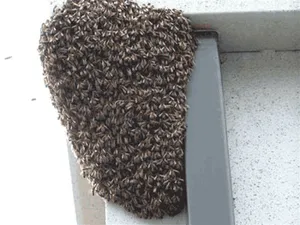
As illustrated in the pictures, bees will swarm around the nest entrance or the queen.
Sometimes these swarms will be found hanging from the branch of a tree or occasionally as illustrated in the photos, on the side of a building, the queen will be at the centre of the swarm as the workers surround her.
Wasps do not generally swarm in this manner unless the entrance to the nest is blocked up.
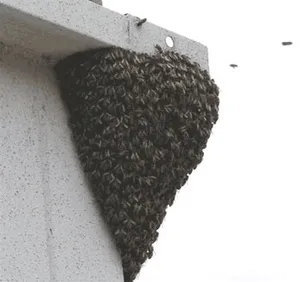
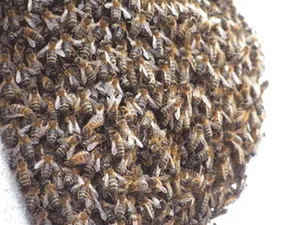
For more info please take a look at our page: information on honey bee removal
Mason bees and Mining bees
Both Mason and Mining bees are solitary and valuable insects that contribute to pollination. They are most active during April and May and have a lifespan of approximately six weeks.
These bees prefer nesting in various locations, including holes in walls, plastic weep vents in brickwork, and gaps in PVC windows and doors. Their nesting process involves laying eggs, which they pack with pollen and mud. If you come across an old hole or air brick filled with mud, Mason bees will likely be the culprits.
While local Mason bee populations are usually low, numbering just a few individuals, their numbers can increase in some years, reaching 50 or more at a single location. Leaving them undisturbed to carry out their crucial pollination activities is recommended. They pose no harm and, in return, contribute positively to the ecosystem.
On the other hand, Ivy bees are active in late summer and typically appear in larger numbers, often in the hundreds, sometimes thousands. If you observe numerous small bee-like insects on your lawn in late summer burrowing into the ground, they are likely Ivy Bees. It is advisable to ignore them and let them be, as they will soon disappear.
It is worth noting that only female bees have an ovipositor, and both Mason and Mining bees are highly unlikely to sting, making them generally harmless and beneficial contributors to the environment.
Due to their yellow/golden colour, Mason bees are often mistaken for wasps in early spring. The simple way to distinguish between the two is: bees are fluffy, wasps are bald.
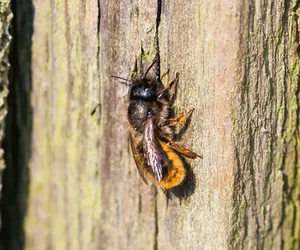
Similar to Mason bees, mining bees nest in the ground, they make small holes which are slightly larger than wormholes with a small mound at the surface resembling a mini volcano. There are various types of mining bee which are active in the spring.