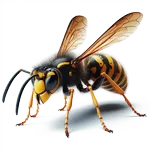
Wasp life cycle
The wasp life cycle can be organised into four main parts:
- Hibernation/Diapause - Newly hatched queen wasps hibernate during winter, preparing for the upcoming spring.
- Nest establishment - In spring, queen wasps emerge from hibernation and select a location to establish a new nest.
- Egg laying, pupation and colony expansion - The queen lays eggs once the nest is established. These eggs hatch into larvae, then grow and pupate into adult wasps. Throughout the summer, the nest expands to create more cells for egg and larvae production.
- Queen production and mating - As the season progresses towards late summer and autumn, the nest produces new queens and males. These new queens and males leave the nest to mate. The males die, and the newly mated queens hibernate over winter. This entire process represents the annual reproductive cycle of wasps.
Hibernation
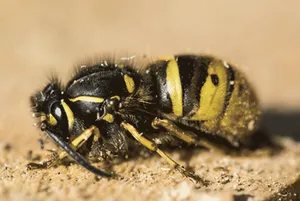
During the winter, queen wasps go into a state of hibernation called diapause. During this time, there are no worker wasps around. Queens usually find a shelter where the temperature is stable, such as sheds, woodpiles, lofts, or old rabbit burrows and mouse holes underground.
Colder winters are better for hibernating wasps because they stay in hibernation longer, avoiding emergence when plants that produce nectar are not available as a food source.
In spring, when they wake up from hibernation, a queen wasp first looks for food. Adult wasps can only consume liquid foods and usually obtain nectar from flowers. It's worth noting that queen and initial worker wasps of the season contribute to pollination as they replenish their energy with nectar.
The photo accompanying this text shows a live queen wasp in hibernation.
Nest establishment
A wasp nest is started by a single wasp called the queen. To start the construction, the queen selects a location for the nest, which can be varied and unconventional, such as loft spaces, sheds, holes in the ground, unused mouse or vole holes, and old rabbit burrows.
To build her nest, the queen gathers dead wood from fences, sheds, or dead/dying trees. She creates a paste by combining saliva with the stripped wood and employs this mixture to construct the nest.
Please refer to the attached video for a visual demonstration of a queen wasp collecting nesting material from a wooden post.
At times, the impact of wasps stripping wood is noticeable, leaving marks on the surfaces of fences and wooden doors. An illustrative example of this can be seen in the accompanying photo.

Egg laying and colony expansion
The nest initiation begins as the queen forms a solitary cell at the end of a central stalk called the petiole. Subsequently, six additional cells are added around this initial cell, forming the characteristic hexagonal pattern of the comb.
After the completion of the initial starter comb, the queen proceeds to lay eggs in each cell. Concurrently, she initiates the construction of the outer shroud around the nest.
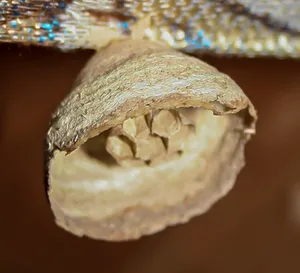
As the nest progresses, the combs expand, additional layers of combs are also added.
The inside view of a wasp nest (the outer shell has been removed).
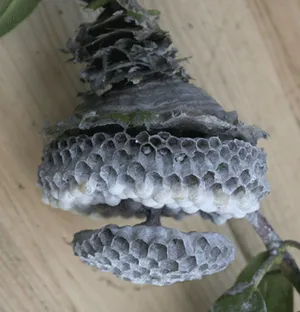
As the nest expands, new cells are incorporated around its outer edges. Capped cells are visible in the central part of the nest, while the outermost cells contain younger larvae.
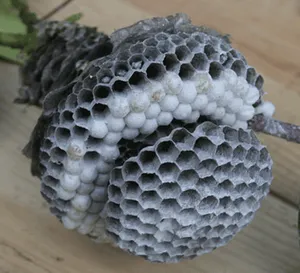
After the eggs hatch and progress through the larval stage, they undergo pupation and eventually emerge as adult worker wasps. These workers assume most day-to-day responsibilities within the nest, including tasks such as nest maintenance, foraging for food, caring for young wasp larvae, building the nest, and collecting water.
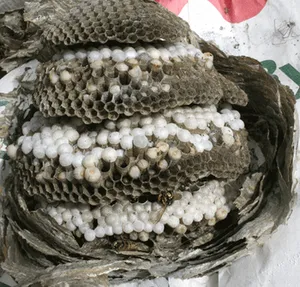
The accompanying image depicts the wasp larvae enclosed within the brood cells.
When prepared to undergo pupation,
they spin a silk cap over the top of the cell, marking the beginning of their transformation into adult wasps.
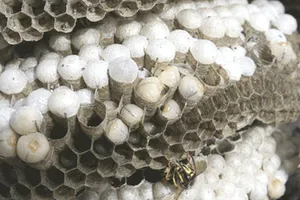
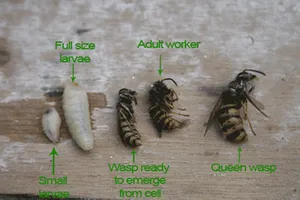
The provided image displays the various stages of a wasp's life development. The process begins with the queen laying an egg, then developing into a small larva. As the larvae grow, they eventually reach full size. When they mature, they undergo pupation, transforming into adult worker wasps.
The final image illustrates the layered structure of the nest, presented in its correct orientation with cells pointing downward.
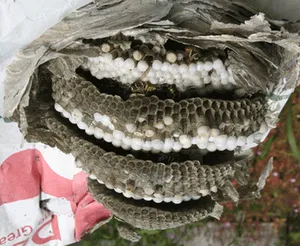
Each wasp nest or colony includes a single queen; the rest are sterile female worker wasps.
Young wasps (larvae) are fed on insect prey (protein). You can watch our video of a worker wasp dissecting a honey bee, which will then return to its nest to feed larvae.
Maintaining the correct temperature is crucial within a wasp nest—too low, and the larvae may chill; too hot, and they risk succumbing to the heat. In hot weather, wasps actively collect water, spraying it into the nest to regulate the temperature. When the nest comes into contact with a ceiling or wall, this water application can occasionally result in staining as it permeates the surface.
Wasp feeding behaviour
It is a common misconception that wasps primarily feed on insects. In reality, adult wasps feed on nectar, sweet fruits, or sugary liquids as they do not have mouthparts for solid food such as insect parts. Wasps have a unique feeding system where adults feed insect prey to their larvae. The larvae, in turn, convert insect shells (chitin) into a sugary substance, which acts as a super energy drink for the adult wasps. This feeding process is consistent across common wasps, German wasps, and hornets. When a nest produces new queens and the last batch of larvae is complete, the wasps transition to 'sweet feeding.' This change occurs because there are no more larvae to feed, resulting in a cessation of food production by the larvae. Consequently, during the later summer months, wasps may be observed pestering individuals in outdoor settings like pub gardens.
As sweet feeding commences in late summer/early autumn, the quality of the sugar in the wasps' diet diminishes, and they are forced to search for energy-producing food to sustain flight. This persistent and annoying behaviour results from their desperate quest for nourishment. Contrary to popular misconceptions, wasps do not become intoxicated from fermenting foods; their seemingly erratic behaviour is attributed to starvation and a lack of energy due to subpar food sources.
Queen production and mating
Towards the end of summer, the last group of larvae is produced. This group consists of new queens and fertile male drones. Once the new queens and drones emerge from pupation, they leave the nest permanently. No more food is available for the worker wasps or the original queen inside the nest, marking the time of year when wasps might become a nuisance to people in outdoor settings as they search for sweet food sources.
As food sources continue to deplete, the worker wasps and the original queen face starvation. It's important to note that the reproductive members of the nest are the new queens and males, not the workers.
After leaving the nest, the new queens and males mate. The male drones die after mating, while the now fertile queens hibernate throughout the winter months. They are ready to initiate a new nest and colony in the following spring.
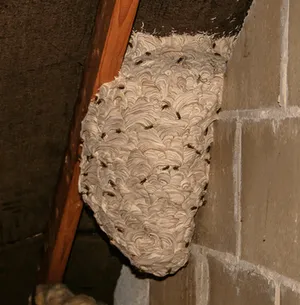
Common Wasp; Vespa Vulgaris
In the UK, the two most common types of "social wasps" are the common wasp (Vespa Vulgaris) and the European wasp (Vespula Germanica), which are prevalent across much of the northern hemisphere.
Common wasp nests can be found in various locations, including buildings, hollow trees, sheds, air bricks, behind tile hanging, or virtually any dry space. They may establish nests in disused vehicles or beneath hot tubs. Occasionally, These wasps take over rabbit or rodent burrows and construct nests underground.
The common wasp, or "Jaspers," measures approximately 17-20mm in length.
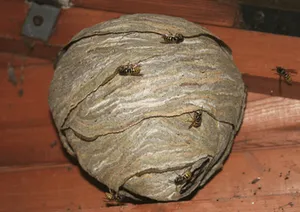
European Wasps; Vespula Germanica
The European wasp (Vespula Germanica), also known as the "German Wasp." Despite some newspaper reports, these are not a new strain of 'Mutant Euro Wasp' poised to take over the world.
The European wasp nest is constructed similarly to the common wasp nest. However, instead of being underground or inside buildings, European wasp nests are usually found closer to the ground, in bushes and trees. The nest's structure is the same as that of the common wasp. The life cycle of the European wasp is the same as that of the common wasp, with a single queen and sterile worker wasps responsible for tasks such as nest building, repair, and foraging for food.
Compared to the common wasp, the European wasp is slightly larger and prefers to collect various insects to feed its larvae. It's also worth noting that there is a third type of social wasp called the Hornet. More information about the European Hornet can be found separately.
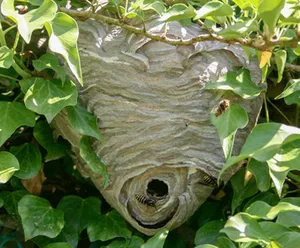
Median Wasps
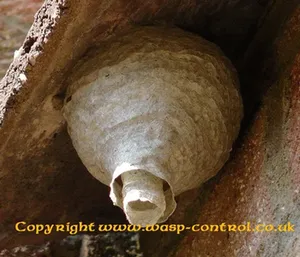
Median wasps, akin to common wasps, are notably less abundant. The appearance of their nest resembles that of a common wasp nest but has a distinctive feature of a tube-like entrance located at the bottom.
Wasp Nest Population: Variances and Factors
The quantity of wasps within a nest depends on various factors and can fluctuate with the changing seasons.
For instance, the population of common wasp nests can escalate by the end of summer (August/September), potentially accommodating up to 5,000 or more individuals.
In the case of European wasps, their nests may house up to approximately 1,000 individual wasps.
It's important to note that external elements such as weather conditions and food availability contribute to the yearly variations in wasp populations.
For more information on identifying the presence of a wasp nest, please refer to our page: how can I tell that I have a wasp nest?