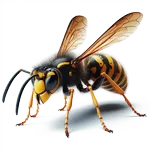
Honey bee swarms, dealing with honey bee nests in your home
We are no longer in the business of collecting honey bee swarms or removing colonies from buildings but don't worry, we've got some helpful info that might just be what you need!
Let's chat about honey bee swarms versus a honey bee colony. Together, we'll figure out precisely what's buzzing around your place!
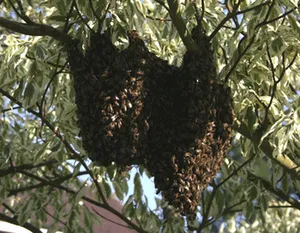
The honey bee swarm.
A honey bee swarm comprises a queen bee and numerous worker bees. Unlike a honey bee colony, swarms lack a permanent home.
Swarming occurs when a colony becomes too large or lacks space for additional workers. The original queen departs with some worker bees to establish a new colony, while those remaining in the original nest raise a new queen. Some colonies may swarm multiple times in a year.
Swarming bees appear and disappear suddenly in your garden without warning signs. Typically, they land on a branch or the side of a building, with the queen at the centre. During this homeless phase, the bees search for a suitable place to establish a new home.
It's advisable to wait a few hours before seeking professional removal, as the swarm may leave on its own.
If you need a swarm removed:
- For North Hampshire, please visit: Andover Bee keepers Association
- For the Basingstoke area, please visit: Basingstoke bee keepers
- Alternatively, you can find a list of honey bee swarm collectors here: List of UK honey bee swarm collectors
When bees swarm in this manner, they lack a home to protect and are generally non-aggressive. Having fed on honey before leaving, they are satiated and less likely to sting. Nonetheless, avoiding interfering without proper protective clothing, as with any potentially stinging insects, is recommended.
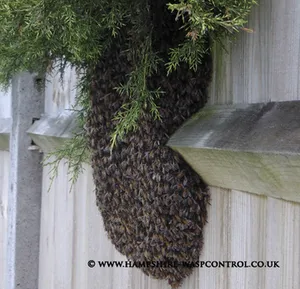
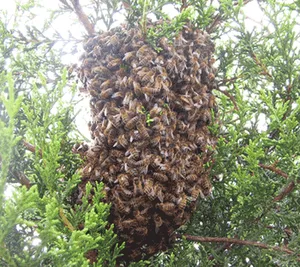
The honey bee colony.
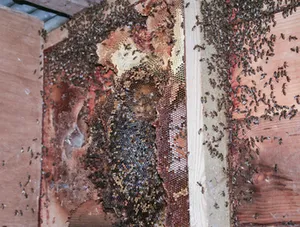
A honey bee colony represents an established nest with a functioning honeycomb containing honey stores and young bees.
Honey bees often nest in buildings, favouring chimneys, roof spaces, and cavity walls to establish their working honeycomb.
The honeycomb, crafted by the bees from wax, serves two primary functions. Firstly, it stores honey derived from incoming nectar. The bees evaporate the nectar within the comb, subsequently capping individual cells to preserve the freshness of the honey and prevent it from drying out and hardening. This stored honey becomes crucial during times of food shortage and throughout the winter.
Secondly, the honeycomb provides a space for the queen to lay her eggs and serves as a nursery for young bee larvae.
A honeycomb present in a house, often found in chimneys, even after the original builders have departed, can attract other bees. The scent of honey stores and beeswax may draw swarms from a considerable distance.
Suppose you notice a yearly influx of bee swarms or recurring bee nests. In that case, it's likely that a honeycomb exists somewhere on your property, possibly in a disused chimney.
It is essential to understand that bees do not hibernate like wasps. They store food (honey) to sustain themselves during the winter. A colony can persist in the same location year after year. During winter, bees may not be visible outside due to the cold. Still, they remain alive and clustered in a warm spot, eagerly awaiting the arrival of spring.
Removal of bee swarms.
If you are faced with a bee swarm, there's no need to panic. Reach out to your local beekeeper's association, who will coordinate a prompt and hassle-free removal of the swarm.
Beekeepers are generally eager to collect and relocate swarms, making the process swift and straightforward. The accompanying image illustrates a swarm being successfully re-homed.
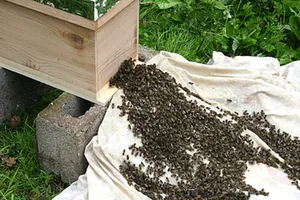
Please take a look at our video of a small honey bee swarm being walked into a hive
Treating honey bee colonies.
Occasionally, a swarm of honey bees may establish a new colony in an inappropriate location, such as someone's home or another unsuitable space. In cases where the colony decides to remain and extraction is not feasible, or the homeowner cannot coexist with them, the unfortunate but necessary step may be to eliminate the colony. We must note that we do not undertake bee treatments regardless of species.
Suppose you encounter a swarm settling in a challenging location. In that case, waiting for a day or so before taking any action is recommended. Frequently, the bees may decide to move on their own.
Should the bees choose to stay, we advise contacting your local beekeeping association to explore options and discuss the best course of action.
Mason bees and Mining Bees.
Mason bees, often confused with wasps in spring, are solitary insects with beneficial roles in the ecosystem. We encourage you to let them be, as they play a valuable role in pollination.
These bees emerge in mid-spring and remain active for about six weeks. After mating and laying eggs, they will naturally disappear. If you spot mason bees one year, they'll likely return the following year, which is a positive occurrence.
Mason bees prefer nesting in tiny holes, such as disused crevices in brickwork or plastic weep vents in modern brick structures. They may also lay eggs in gaps around PVC windows and doors, recognizable by mud or sand tightly packed around crevices or holes in air bricks or old brickwork.
It's important to note that only female mason bees can sting, and their stings are weak. They are unlikely to sting unless accidentally harmed.
Similarly, mining bees, akin to mason bees, are beneficial insects with minimal sting risk. They create small burrows in the ground, forming holes slightly more prominent than wormholes, often with a small heap of soil resembling a miniature volcano on top.
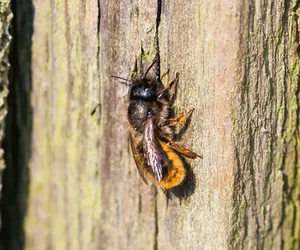
Mining bees, much like their counterparts, mason bees, play a vital role as beneficial insects in our ecosystem and are highly unlikely to pose a stinging threat.
These industrious bees engage in the fascinating behaviour of burrowing into the ground, creating tiny holes just a tad larger than typical wormholes. As they meticulously carry out their nesting activities, a distinctive hallmark of their presence is the small mound of soil adorning the entrance, resembling a miniature volcano. This unique behaviour showcases their resourcefulness and contributes to the natural processes of soil aeration and nutrient cycling.
The mining bee's unobtrusive nature makes them excellent pollinators, enhancing local flora's overall health and biodiversity. Unlike more aggressive species, mining bees are known for their docile behaviour, making them unlikely to sting unless provoked or inadvertently threatened. Therefore, their presence in the environment is a testament to the delicate balance and symbiotic relationships that characterize our intricate natural world.
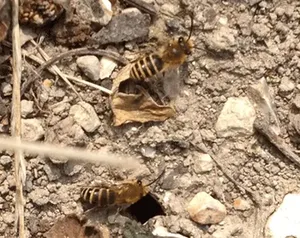
Important Note: We want to emphasize that we do not engage in the treatment of any bee species.
Mining and mason bees, often mistaken for wasps, pose minimal harm and are highly unlikely to sting. The stinging capability is exclusive to female mason bees, and even then, their stings are notably weak, often going unnoticed.
If you have mason bees on your property, consider leaving them undisturbed, as they are beneficial insects contributing to pollination. However, if coexistence is not an option, a viable solution involves hiring a builder to re-point your brickwork or blocking any holes they may be utilizing.
When mining bees create burrows in your lawn, it's advisable to let them be, as they will naturally vacate the area. Intervening with their activities is unnecessary and may disrupt their natural lifecycle.